Core Concept and Objective
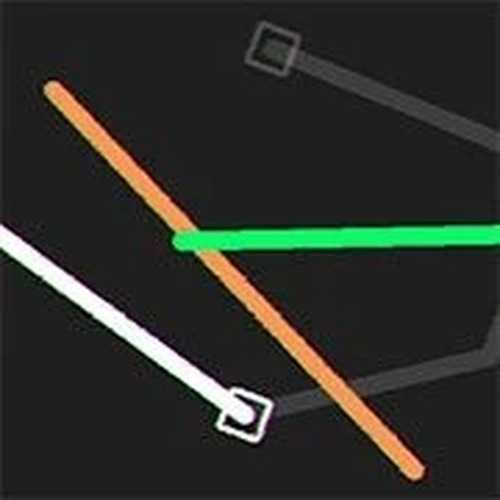
Path Linking Puzzle presents a straightforward challenge: connect designated points on a grid by drawing a continuous line while stationary and moving barriers threaten to break the connection. The game strips away unnecessary elements, leaving only the essential interaction between player input and environmental hazards. This purity of design means every decision matters, and a single mistimed movement can force a restart. The visual simplicity helps players focus entirely on the task without visual clutter.
Obstacle Patterns and Progression
As players advance, the arrangement and behavior of barriers become more varied. Early stages might feature a few slow-moving lines, while later ones introduce faster speeds, multiple simultaneous hazards, and tighter pathways. The game does not rely on random generation; instead, each layout is carefully crafted to teach a specific timing or routing skill. This structured difficulty curve ensures that players build competence gradually, with each new pattern feeling like a logical step forward rather than an arbitrary spike in challenge.
Controls and Responsiveness
Input methods are limited to mouse or touchscreen, with the game recognizing drag gestures to trace the connection path. The controls feel immediate and accurate, with no noticeable lag between player action and on-screen response. This responsiveness is critical because the game demands split-second adjustments when barriers approach. The interface remains uncluttered, with no buttons or menus intruding during play, allowing full immersion in the puzzle-solving process.
Visual and Audio Design
The visual style uses clean lines, muted colors, and ample negative space to keep the focus on gameplay elements. Points are clearly marked, barriers are distinct in shape or color, and the connection path is highlighted for easy tracking. The electronic soundtrack provides a steady, rhythmic beat that matches the pace of play without becoming distracting. Sound effects are minimal but informative, signaling successful connections or interruptions without overwhelming the player.
Family-Friendly Accessibility
The game avoids any content that might be unsuitable for younger players, making it appropriate for family gaming sessions. Its simple premise means even beginners can understand the objective within seconds. The lack of complex instructions or steep learning curves lowers the barrier to entry, while the increasing difficulty offers enough depth to keep experienced puzzle fans engaged. Sessions can be as short as a few minutes, fitting easily into breaks or casual playtime.
Compatibility
This H5 game runs smoothly on:
• Desktop computers (Windows / Mac) • Mobile phones (iPhone / Android)
• Tablets (iPad / Android)
🌐 Best experienced with Chrome, Safari, or Edge








Player Comments
Sign in to comment
You must be logged in before posting a review or rating.
No account? Create one
No comments yet. Be the first to comment!